Every year, OBI announces the recipients of its Neurotech Entrepreneurship to Validate Emerging Innovations (NERVE) program, Canada’s single largest award for early-stage neurotechnology entrepreneurs. Each receives $100,000 in non-dilutive funding, along with 12 months of mentorship, training, and commercialization support.
The background and demographics of NERVE applicants change year-to-year. Some innovation types are more common than others, but the stories behind each entrepreneur remain unique and inspiring. The 2026 cohort spans a range of neurotechnology ventures, from neuroprosthetics and digital mental health to concussion recovery and tools for neurodivergent children and underserved communities.
From personal experience to neuroprosthetics
Take Ahmed Ibrahim, Founder and CEO of Better Bionics. Growing up in Iraq and Syria, Ahmed witnessed how wartime amputations affected his peers, contributing to stigma and social isolation. He decided to take on the challenge himself.
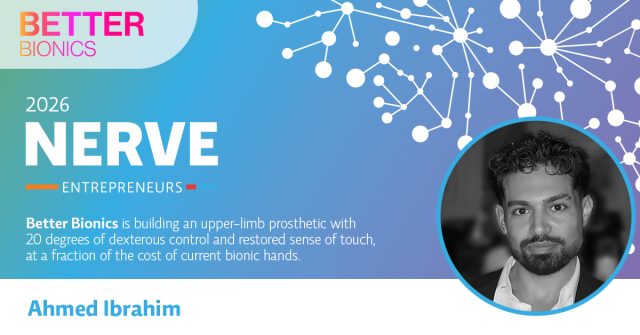
His first attempt at building a robotic arm was far from functional, assembled using parts from an RC helicopter and a soldering iron. But each unsuccessful attempt brought a new lesson. “Every broken attempt taught me something about what working actually meant,” Ahmed recalls.
After immigrating to Canada, Ahmed pursued studies in neuroscience at Brock University and McMaster University. Most recently, Better Bionics graduated from McMaster’s The Forge Spring ‘26 Business Incubator cohort. Through NERVE, Ahmed is continuing to develop his vision for more functional neuroprosthetic technologies.
Advancing mental health assessment through research
For others, entrepreneurship represents the next step in translating years of research into practical tools. Diya Shah, CEO of Prescia Health, is turning her research experience into a digital tool designed to support more objective psychiatric assessment and triage. As a research analyst with the Centre for Addiction and Mental Health (CAMH), Diya has worked on the research, development, validation, and clinical deployment of Prescia’s digital platform through CAMH’s Krembil Centre for Neuroinformatics.
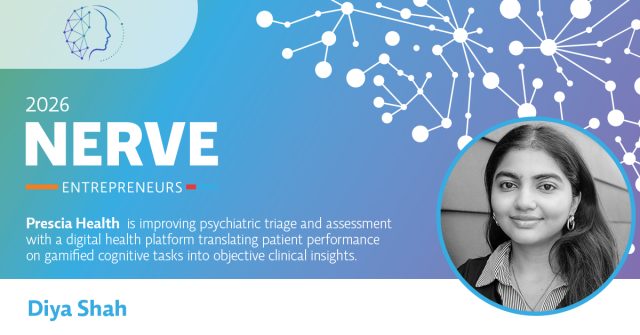
Through the platform, patients complete gamified cognitive tasks that measure neurophysiological and behavioural patterns, generating information that can support clinical decision-making. “Mental health systems urgently need faster, more objective tools for early triage,” asserts Diya.
Extending concussion recovery beyond the clinic
Sam Turgeon-Brabazon is scaling Crossbridge, a remote platform designed to support concussion recovery from home. His background in entrepreneurship, interdisciplinary innovation and business consulting is complemented by a family connection to traumatic brain injury care through psychology and psychotherapy.
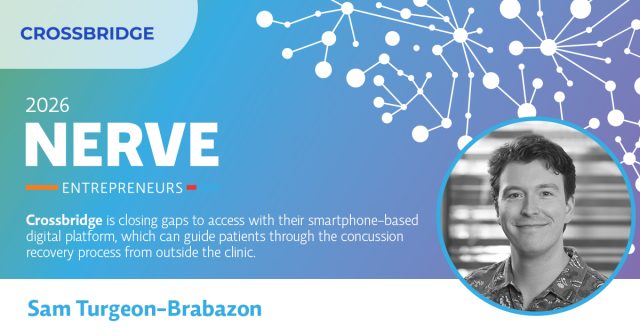
Crossbridge is being jointly developed with Dr. Roger Zemek, Dr. Sharon Johnston, researchers from the OBI’s TRANSCENDENT Concussion Research Program, and Alex Johnston of 360 Concussion Care. With NERVE support, the Crossbridge team is working to bring concussion recovery into patients’ homes, making care more accessible beyond traditional clinical settings.
Turning real-time signals into proactive care
For James Elson, founder and CEO of Attune Kids, the idea behind Attune is rooted in both innovation and lived experience. With more than 20 years of experience building and commercializing technology, and as a parent to neurodivergent children, James brings both technical expertise and firsthand insight into the challenges youth and families can face.
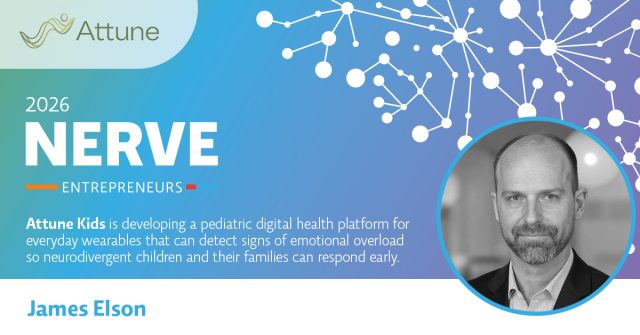
Attune uses everyday wearables to capture real-time physiological signals and identify early signs of emotional overload. The digital health platform builds on more than a decade of paediatric research from Holland Bloorview Kids Rehabilitation Hospital, translating that research into a tool designed for use by families and care teams.
“Attune was born in the real world, not in a boardroom,” James emphasizes.
Through NERVE, Attune aims to help families and care teams recognize signs of emotional overload earlier, providing greater insight into what a child may be experiencing and enabling them to respond proactively.
Bridging gaps in mental health care
Shinjni Sharma, a 2025 NERVE entrepreneur and founder of Mellow Labs, is exploring how technology can help make mental health care more accessible. With a background in educational technology and SaaS, she has helped scale multiple companies and founded four ventures, including Mellow Labs, which develops accessible, non-invasive technology solutions for mental health.
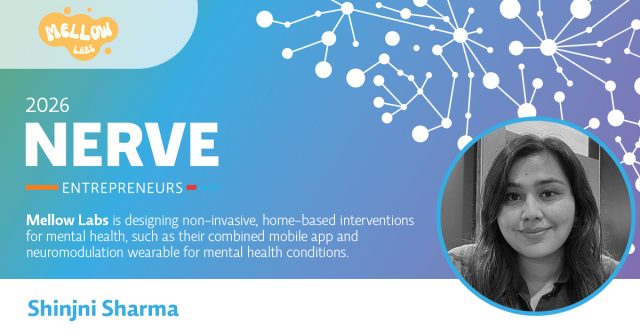
Shinjni’s current studies in therapy, together with her own experiences navigating the healthcare system, have broadened her perspective on how mental health care can be delivered. Mellow Labs is developing solutions with underserved communities in mind, particularly for people who may experience barriers to accessing care.
At the heart of Mellow Labs’ vision is a commitment to accessibility and equity, using technology to help more people and communities access mental health care.
Looking ahead
From neuroprosthetics and digital mental health to concussion recovery and neurodivergent care, the NERVE program reflects the breadth of innovation emerging across brain health. Previous NERVE entrepreneurs have gone on to gain clinical validation, refine their technologies, attract additional investment and expand into markets beyond Canada.
The 2026 cohort is now embarking on that journey, turning their ideas into technologies with the potential to reach more people and address real-world needs in brain health.
Learn more about the NERVE program